
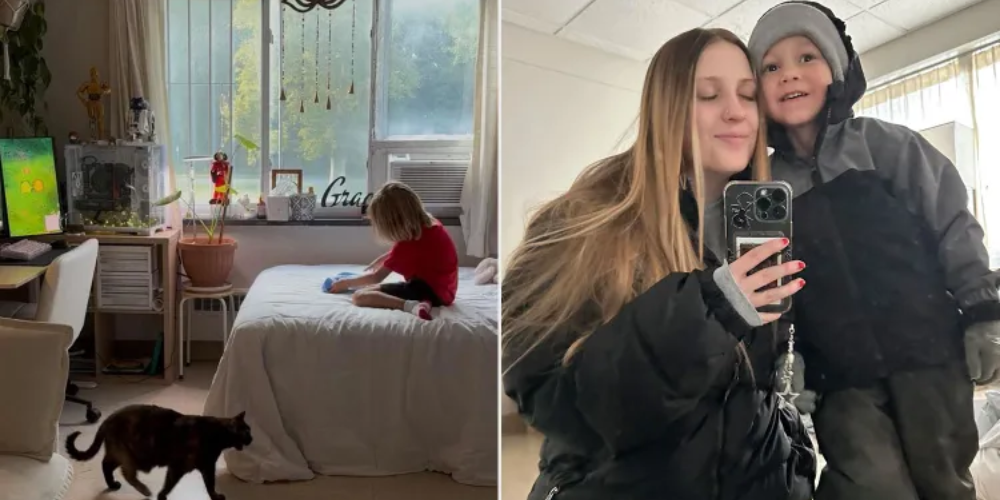
Raising a child while attending college can bring challenges that most students never face. For Grace D’Amato, however, college housing has become more than a place to sleep. She lives there with her 6-year-old son, Matteo, as part of a program built for student parents.
The arrangement has drawn questions online, especially after D’Amato shared a TikTok marking her and Matteo’s final college move-in before her senior year. Some viewers wondered why a young child would live on a college campus.
D’Amato says the reality is far removed from the party-focused image many people associate with college dorms.
A Dorm Designed for Student Parents
@damatoduo Update: I did not expect so much confusion, and for that I do apologize! It is hard to explain our situation in a small text on a video, and for us, “mom&son dorm” is normal language. For info on the school and my couch, check the link in my bio. Thank you for those who offer support & helping us reach our follower goal! 🤍 #collegemovein #dormtour #momsincollege #singlemom #youngmom ♬ original sound - ༘🧹 ❝ leo / peter ❞
D’Amato and Matteo live through the school’s Single Parent Scholar Program, known as SPS. The housing brings student parents and their children together in a setting designed around family life.
“It is not a bunch of college students bringing their children into a party environment,” D’Amato tells PEOPLE exclusively. “It is a community specifically designed to allow parents and children to live, learn, and grow together.”
That difference shapes daily life. D’Amato says some people feel uncomfortable when they hear that a child lives in a college dorm because the setup is unusual. Still, she points out that being different does not automatically make an environment harmful.
School, Meals and Playtime
A normal weekday starts with D’Amato and Matteo getting ready for school and having breakfast together. She then walks him to the bus. Matteo recently started first grade while his mother began her senior year.
D’Amato plans her classes and work around his school schedule. At times, she also brings him to class when necessary. Once Matteo returns from school, the dorm takes on a more family-centered rhythm.
D’Amato lives on the same floor as two other moms and their children. The families often gather for dinner. One mom may cook while the others help clean, creating what they jokingly call “family dinner.”
The children have developed their own close bond. They move between rooms, play in the shared playroom and spend much of their free time together. D’Amato says they have become so close that they view one another as siblings.
“They see each other as siblings,” she says. “They are constantly running from room to room looking for each other, playing together, and including everyone in whatever they are doing.”
A Support System for Single Moms

Facebook | Gracie D'Amato | Matteo builds close bonds with his mother and their campus friends, creating a supportive family away from home.
The shared setup also gives D’Amato practical support. The moms divide household tasks, help when someone needs an extra hand and sometimes give each other time to rest.
For D’Amato, that support matters as she balances college and parenting. She even points to one simple benefit of having other parents nearby: “Nothing beats a nap as a single mom.”
The program has also helped with housing costs. D’Amato says SPS housing is free for full-time students. Families can also stay during the summer instead of leaving when traditional campus housing closes, although the program has additional requirements.
The arrangement still involves trade-offs. D’Amato lives about three and a half hours from her parents. Even so, she says the experience has given her two best friends and three “bonus kids.” Matteo has also gained three “siblings” and two “bonus moms.”
Why Matteo Calls the Dorm Home
For D’Amato, the biggest misunderstanding comes from the phrase “college dorm.” The space may sit on a college campus, but Matteo experiences it as his home.
“The children see very little difference between living on campus and living in a house or apartment,” D’Amato says. “To them, this is simply home. Their friends are here, their favorite people are here, and their entire little community is here.”
D’Amato’s experience shows how college housing can look very different when it serves student parents and their children. Rather than living among typical undergraduate residents, families in the SPS program share routines, responsibilities and childcare support.
For Matteo, the campus is not simply where his mom goes to college. It is also where he goes to school, plays with friends and spends time with people he considers family.